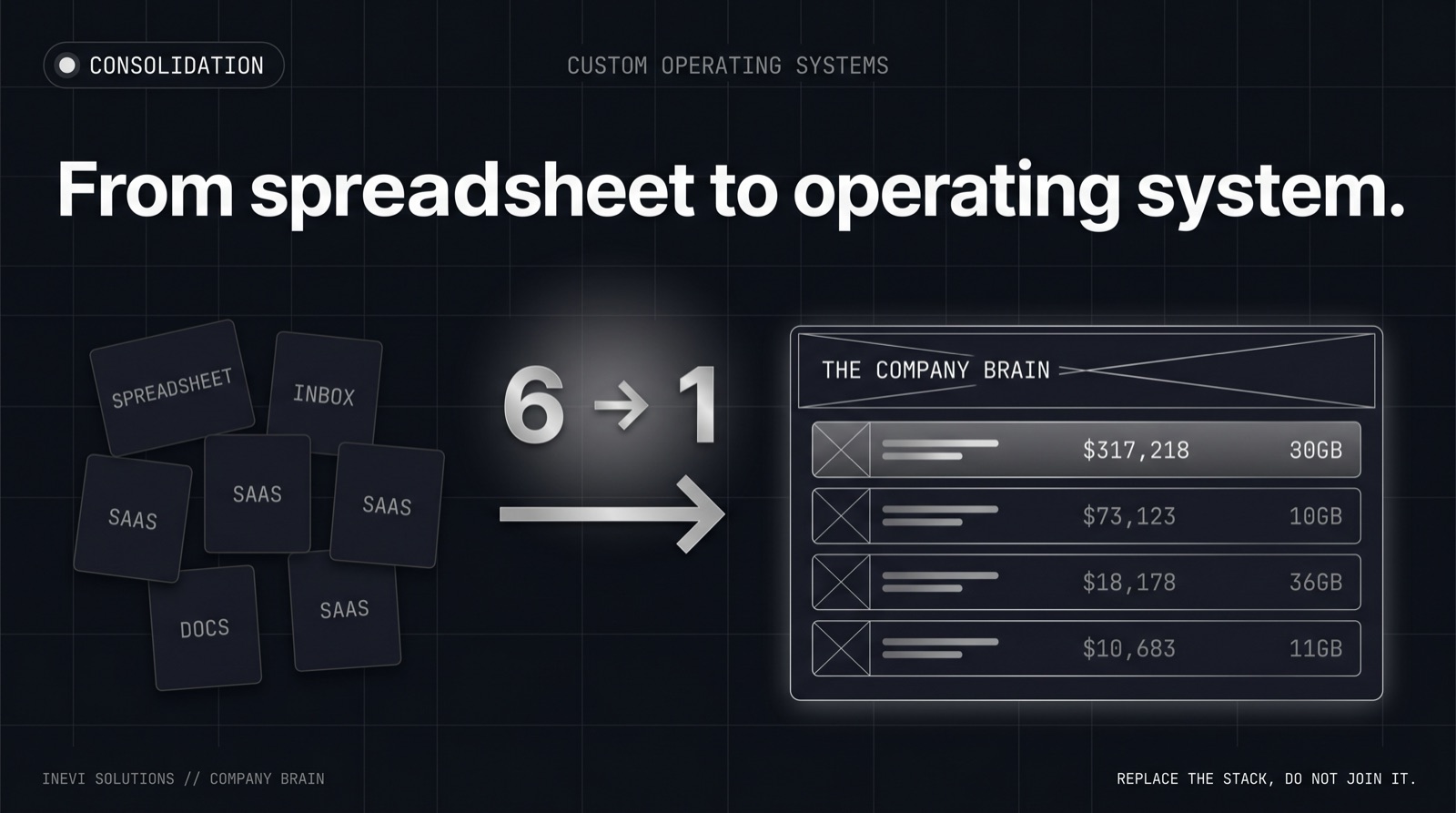
A Company Brain is a custom operating system built for how one company actually runs — a single source of truth, a single interface, and a single data layer that replaces the spreadsheet-plus-shared-inbox-plus-three-SaaS-tools setup that breaks once an operator scales past a certain size. It is not another app added to the stack. It's the thing the stack collapses into.
The distinction matters because almost every vendor an operator talks to is selling an addition. One more tool, one more tab, one more login, one more integration to maintain. The Company Brain framing is the opposite: subtraction. The win is measured in tools removed, not features added.
What actually comes out
When we map a growing operator's stack, the pattern repeats. It's rarely one big system doing the work. It's a constellation of partial systems and the people holding them together:
- Two or three SaaS tools that each own part of a process and none of which own the whole thing.
- A spreadsheet — sometimes several — that's quietly become a system of record because no tool fit.
- A shared inbox or Slack channel where approvals and status updates actually happen.
- An export-reformat-reimport ritual someone runs every week to make two tools agree.
- A person in leadership who is the live integration between all of the above, answering "where does this stand" by hand.
None of those line items shows up as a cost. There's no invoice for "the COO spends six hours a week being the human integration layer." That's exactly why it grows unchecked, and why the cost of doing nothing is consistently underestimated by the people paying it.
What goes in
A Company Brain consolidates that constellation into four layers that sit on one shared stack, so they integrate by default instead of by maintenance:
- 01A custom operating system — the interface and data layer your team actually works inside, built around your workflow instead of a median customer's.
- 02Agentic workflows — the multi-step processes automated end-to-end, with the system making the routing and judgment calls along the flow, not just moving data on rails.
- 03AI employees created from your SOPs — custom AI that runs a specific role end-to-end, governed with audit logs and human-in-the-loop where it matters.
- 04Dashboards and reporting — real-time insight over all of it, so leadership stops being the place status reports get assembled by hand.
The reason these belong together is the data layer. Four tools from four vendors integrate through brittle connectors that break on someone else's release schedule. Four layers on one stack share state by design. That's the architectural difference between a stack and a system.
We run our own business on one
This isn't theory we sell and don't use. We got tired of running our own client pipeline on eight disconnected tools, so we built the system that replaced them. It worked well enough that we turned it into Inevi Acquire and run it continuously on the same infrastructure we build for clients. It's the flagship live case study of what a Company Brain is: signals, enrichment, AI reasoning, pipeline, and outreach in one system instead of six.
The test for whether you need a Company Brain isn't "do we have enough tools." It's "how many hours a week does a senior person spend making our tools agree with each other." Put a number on that and the decision usually makes itself.
Why this is where SaaS is going anyway
Custom software used to be too slow and too expensive to justify against off-the-shelf SaaS. That math has changed. When a system that fits exactly can be built in weeks, paying monthly forever for a tool that fits approximately stops making sense. We think the fragmented stack collapses into the Company Brain across the next few years — that's the first of our seven published predictions, and it's the one we'd stake the studio on.
If your stack has quietly become the thing you manage instead of the thing that manages the work, that's the signal. The fix isn't a better tool. It's fewer of them.
Related: Custom Operating Systems
All posts