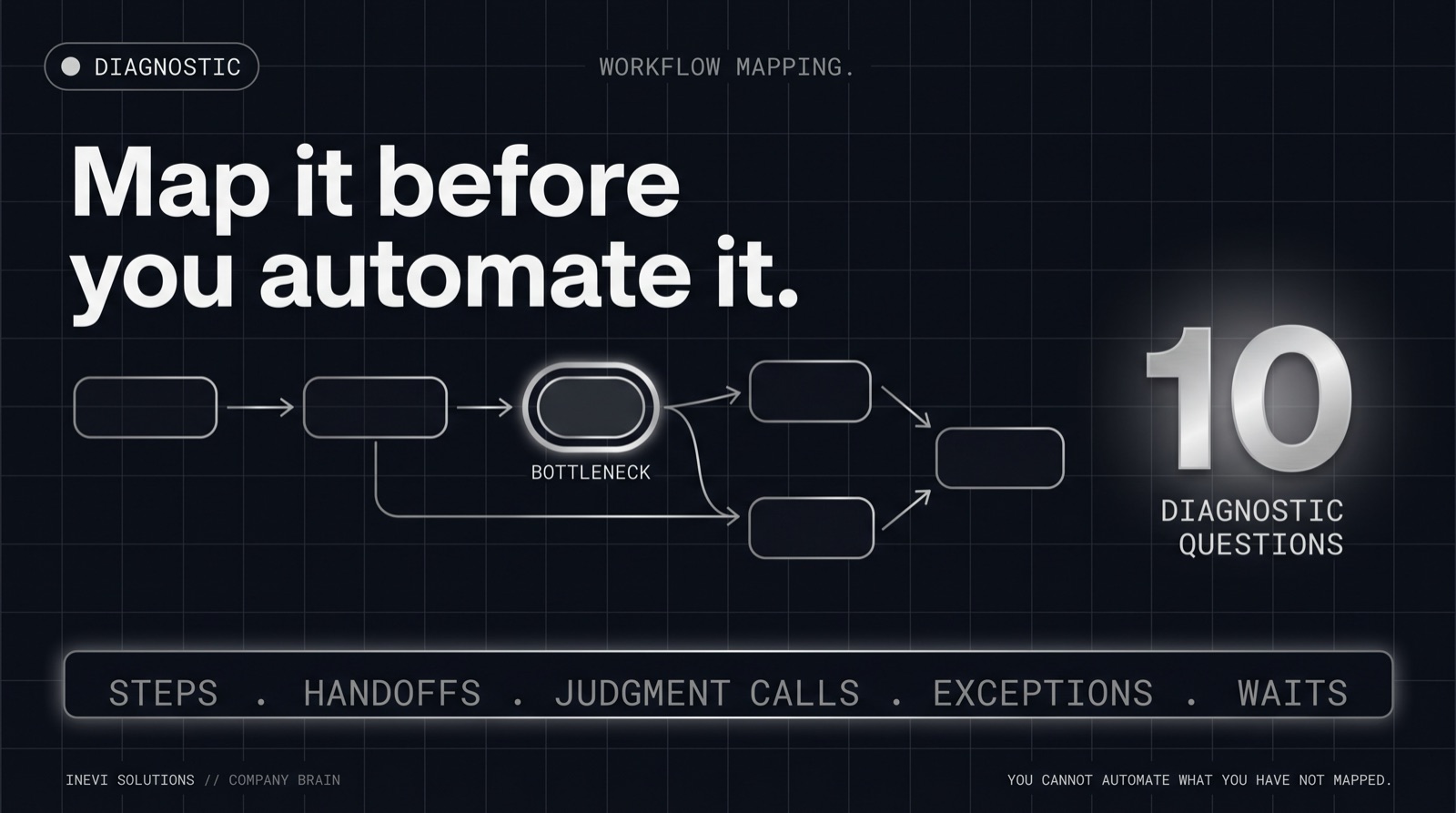
Mapping a workflow means writing down every step, every handoff, every tool, and every decision in a process exactly as it runs today — not as the org chart says it runs. It's the part most teams skip, and it's the single biggest reason automation projects fail. You can't automate what you haven't seen clearly, and almost nobody sees their own workflows clearly until they're forced to draw them.
We map every workflow as the first phase of every engagement. Not because it's billable, but because the map is the thing the rest of the build depends on. Skip it and you automate the wrong steps, miss the branch that actually matters, and ship something the team routes around within a month.
Why unmapped automation fails
The failure pattern is consistent across industries. A consulting firm, a property manager, and an agency owner all describe the same thing: they bought a tool to fix a process, the tool automated the happy path, and the 30% of cases that didn't fit the happy path kept getting done by hand — plus a new tool to babysit. Now there are more tabs, not fewer.
The root cause is almost never the tool. It's that the process was automated from memory instead of from a map. Memory captures the steps you do consciously. It misses the silent ones: the spreadsheet someone keeps on the side, the Slack message that's actually an approval, the judgment call a senior person makes in two seconds without noticing they made it.
The 10-question diagnostic
Run these against any process you're considering automating. Answer them with the person who actually does the work, not the person who manages it. The gap between those two answers is usually where the real bottleneck lives.
- 01Where does the work start? What event or signal kicks this process off, and who or what notices it first?
- 02What are the steps, in order? Every one, including the ones that feel too small to write down. The small ones are where automation pays.
- 03What systems of record touch this? Every tool, spreadsheet, inbox, and doc the work passes through. Count them. The number is usually higher than leadership thinks.
- 04Where are the handoffs? Every point where the work changes hands or changes tools. Handoffs are where time and context leak.
- 05Where are the judgment calls? The points where a human decides something based on context. These are the steps an AI employee has to be taught, not the steps you skip.
- 06What are the exceptions? The cases that don't follow the happy path, how often they happen, and what gets done differently. If exceptions are 30% of volume, automating only the happy path saves you nothing.
- 07Where does it wait? Every queue, every "I'll get to it," every dependency on someone else. Waiting is invisible on an org chart and enormous in real time.
- 08How is it measured today? If the honest answer is "it isn't," that's a finding. You can't prove ROI on a process with no baseline.
- 09What breaks it? The failure modes. What happens when a step is skipped, a system is down, or a person is out.
- 10Who is the human integration layer? The person stitching the disconnected steps together by hand. In most growing companies, that person is in leadership — and that's the cost nobody is putting on the books.
If you can't answer question 6 (exceptions) and question 8 (measurement) with specifics, the process isn't ready to automate. It's ready to map. Those two answers are the line between an automation that sticks and one the team quietly abandons.
What the map gives you
A finished map does three things at once. It shows the bottleneck — almost always a handoff or a wait, rarely a step. It separates the steps that are pure mechanics (automate fully) from the steps that need judgment (an AI employee created from your SOPs, with a human-in-the-loop checkpoint). And it gives you a baseline, so when the system ships you can prove what it saved instead of asserting it.
This is also why mapping is the first paid step in how we work, not a free pre-sales exercise. The map is real intellectual property — you own it whether you build with us or not. See how we work for the full sequence.
Map first, then decide what to build
The order matters. Map the workflow, find the bottleneck, then decide whether the answer is an agentic workflow, an AI employee, a custom operating system, or all three. Deciding the answer first and reverse-engineering the problem to fit it is how you end up with another tool and the same drag.
If you've got a process that takes more hours than it should and you can't cleanly answer the 10 questions above, that's the signal. It means the drag is real and undiagnosed — the exact case the mapping phase exists for.
Related: Agentic Workflow Automation
All posts