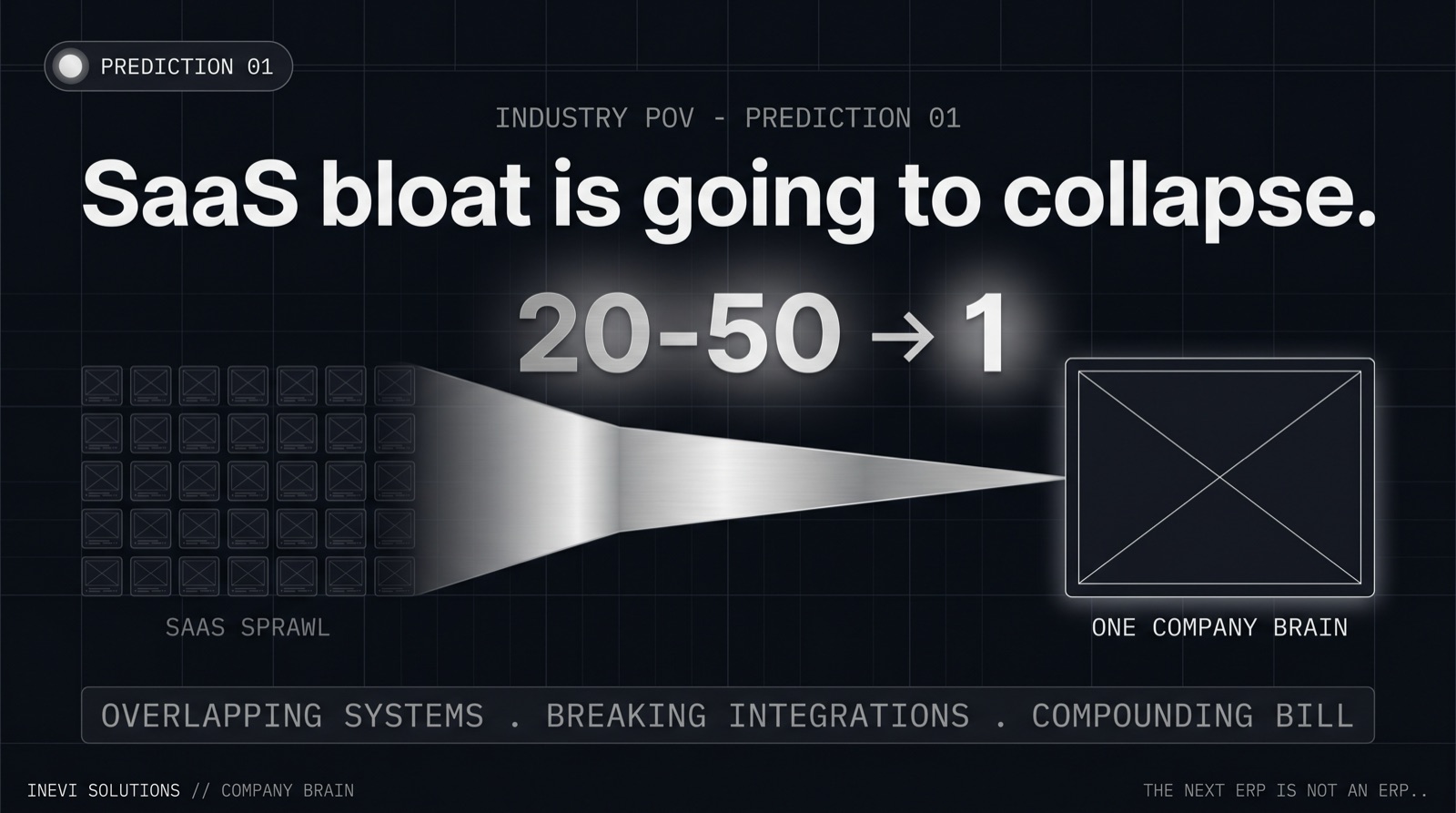
Here's the prediction, stated plainly: the sprawling SaaS stack — the 20 to 50 overlapping tools the average operator accumulates on the way up — collapses over the next few years into custom operating systems that fit one company exactly. Not because SaaS is bad, but because the economics that made the stack rational have flipped. This is the first of the seven predictions we publish and build the studio around. It's the one we're most confident in.
Why the stack exists in the first place
The fragmented stack was never the plan. It's what you get when custom software is slow and expensive and off-the-shelf is fast and cheap. Under those conditions the rational move is always: buy a tool for the new problem. Do that for five years across every department and you arrive at the same place every growing operator does — overlapping systems, redundant workflows, integrations that break on someone else's release schedule, scattered data, a compounding monthly bill, and a person in leadership holding it together by hand.
Every individual buy was reasonable. The aggregate is the thing nobody chose: a company run on tools that don't talk to each other, with humans as the integration layer between them.
Why the economics flipped
The assumption underneath "buy, don't build" was that building is slow and expensive. That's the part that changed. When a custom system that fits exactly can be built in weeks instead of quarters, the comparison stops being "cheap tool now vs. expensive build later." It becomes:
- A tool that fits the median customer, billed monthly, forever, that you maintain integrations for — versus
- A system that fits your operation exactly, built once, that consolidates the stack instead of joining it.
- At a 20-to-50-tool stack with a compounding bill and a human integration layer, the second option stops being the expensive one.
The tell that the flip has reached your company: your most expensive people spend measurable hours every week making your tools agree with each other. When the integration cost is bigger than the license cost, the stack is already the problem, not the solution.
What replaces it
Not one mega-tool, and not a no-code patchwork. What replaces the stack is a Company Brain — a custom operating system with the workflows, AI employees, and reporting on one shared data layer, so the layers integrate by design instead of by maintenance. The SaaS bill goes down. The fit goes up. The human integration layer gets its week back. We've covered what that actually replaces in detail.
The honest version of this prediction has a boundary: off-the-shelf SaaS doesn't disappear. Commodity functions that every company does identically — email, payments, the ledger — stay bought. What collapses is the long tail of tools bought to cover a workflow that's specific to how your company makes money. That's the part that should have been a system and never was.
What to do with a prediction
A prediction is only useful if it changes a decision. This one changes the next "let's just buy a tool for that" conversation. The question stops being "which tool" and becomes "is this the workflow that's core to how we operate — and if so, should it be the next layer of a system instead of the next tab in a stack." Asked early enough, that question is the difference between a 40-tool stack and a Company Brain.
If you read this and thought "that's already us" — the stack already winning, the integration layer already a person — that's not a prediction anymore for you. That's the current state, and it's the exact one we map and replace.
Related: The Company Brain
All posts