The cost of doing nothing is the annual price of running your current manual, fragmented process for another year — and it's almost always larger than the operators paying it think, because most of it never appears on an invoice. Nobody bills you for the six hours a week your COO spends being the integration layer between two tools. So it compounds quietly, and the decision to fix it keeps losing to the decision to live with it.
The fix is arithmetic, not a pitch. Put the status quo on the books and the conversation changes from "is this worth doing" to "why did we wait." Here's the math we use, and that you can run yourself.
The four numbers that make up operational drag
Operational drag almost always decomposes into four costs. Add only the ones that are real for you:
Manual-hours cost   = people × hours/week × 52 × fully-loaded hourly rate
Error cost          = incidents/month × cost per incident × 12
Stuck-capacity cost = senior hours/week × their rate × 52
Avoidable-hire cost = roles you'd hire to cope × fully-loaded cost/role/year

Cost of doing nothing = the sum of whichever of these are real for you
These are the same formulas behind every ROI number we put in a proposal. There's nothing proprietary about the arithmetic — the discipline is being honest about the inputs.
A worked example (illustrative, not a client)
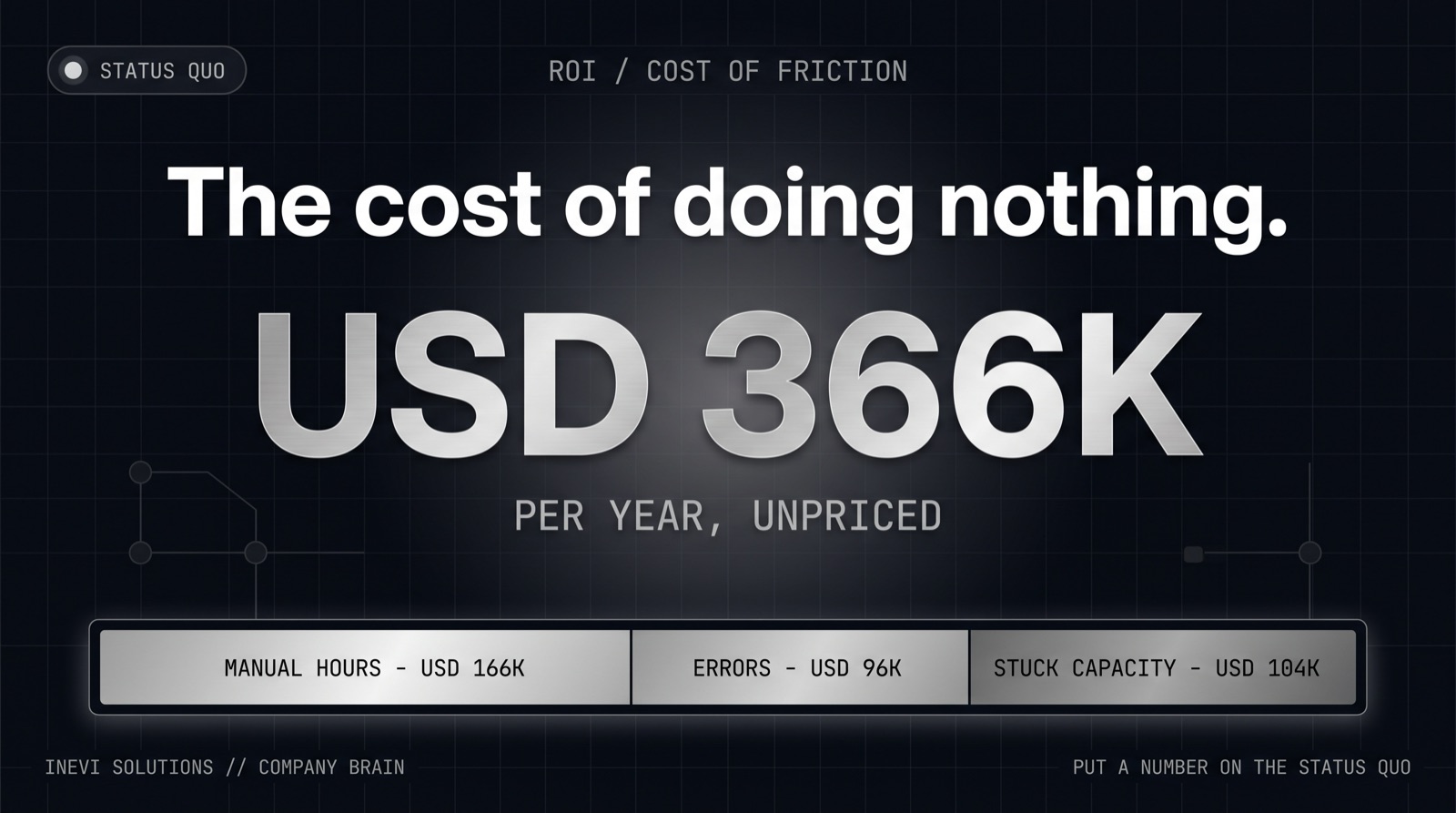
Take a mid-sized operator. Five people spend eight hours a week each on manual admin and moving data between tools, at a fully-loaded rate of $80/hour. Disconnected systems cause about eight error incidents a month at $1,000 each to unwind. A senior person loses ten hours a week to admin that shouldn't reach them, at $200/hour. The numbers, run through the formulas above:
Every input there is conservative and adjustable. The point isn't the $366k — it's that the number was always there, unpriced, being paid every year by a team that experienced it as "things are a bit slow lately."
Run this on your own numbers in two minutes with the ROI Calculator. It uses these exact formulas, shows its math, asks for nothing, and is honest that it's a projection from your inputs — not a quote and not a promise. The number it returns is the one to take to whoever signs off.
Why operators undercount it
Three reasons, every time. First, the largest line — senior people stuck on work beneath them — has no invoice, so it's psychologically free. Second, error cost is counted as the visible incident, never the hours spent unwinding it. Third, the avoidable hire gets framed as growth ("we're scaling the team") when it's often backfill for a missing system. Name all three and the real number roughly doubles.
What to do with the number
Once the cost of the status quo is on the books, the build decision is a comparison, not a leap of faith: the one-time cost of the system against the recurring cost of not having it. Most operating systems we build clear their own cost in well under a year on this math alone, before any revenue upside. The number is also the baseline — ship the system, measure against it, and you can prove the outcome instead of asserting it. That's the point of putting a real-time dashboard over the work: the baseline stops being a slide and starts being live.
If you've never run this math on your own operation, that's the finding. The drag you can't quantify is the drag that keeps winning the budget argument by default.
Related: Dashboards and Reporting
All posts