An AI employee is custom AI created from your detailed SOPs that runs one specific role end-to-end — intake, qualification, ops execution, support, finance — trained on your knowledge with retrieval, governed with audit logs, and built to escalate to a human on the calls that need one. It is not a generic AI agent with your logo on it. The market mostly sells the second thing and calls it the first, which is why so many operators have tried "an AI agent" and watched it not stick.
We use the term "AI employee" deliberately, and we don't use "AI agent" for what we build. The framing isn't cosmetic. An employee is accountable for an outcome, follows a procedure, and has a manager it escalates to. A generic agent is a capable demo with none of those three properties. The gap between them is exactly the gap between a good demo and something you can run a business on.
Why generic AI agents fail in production
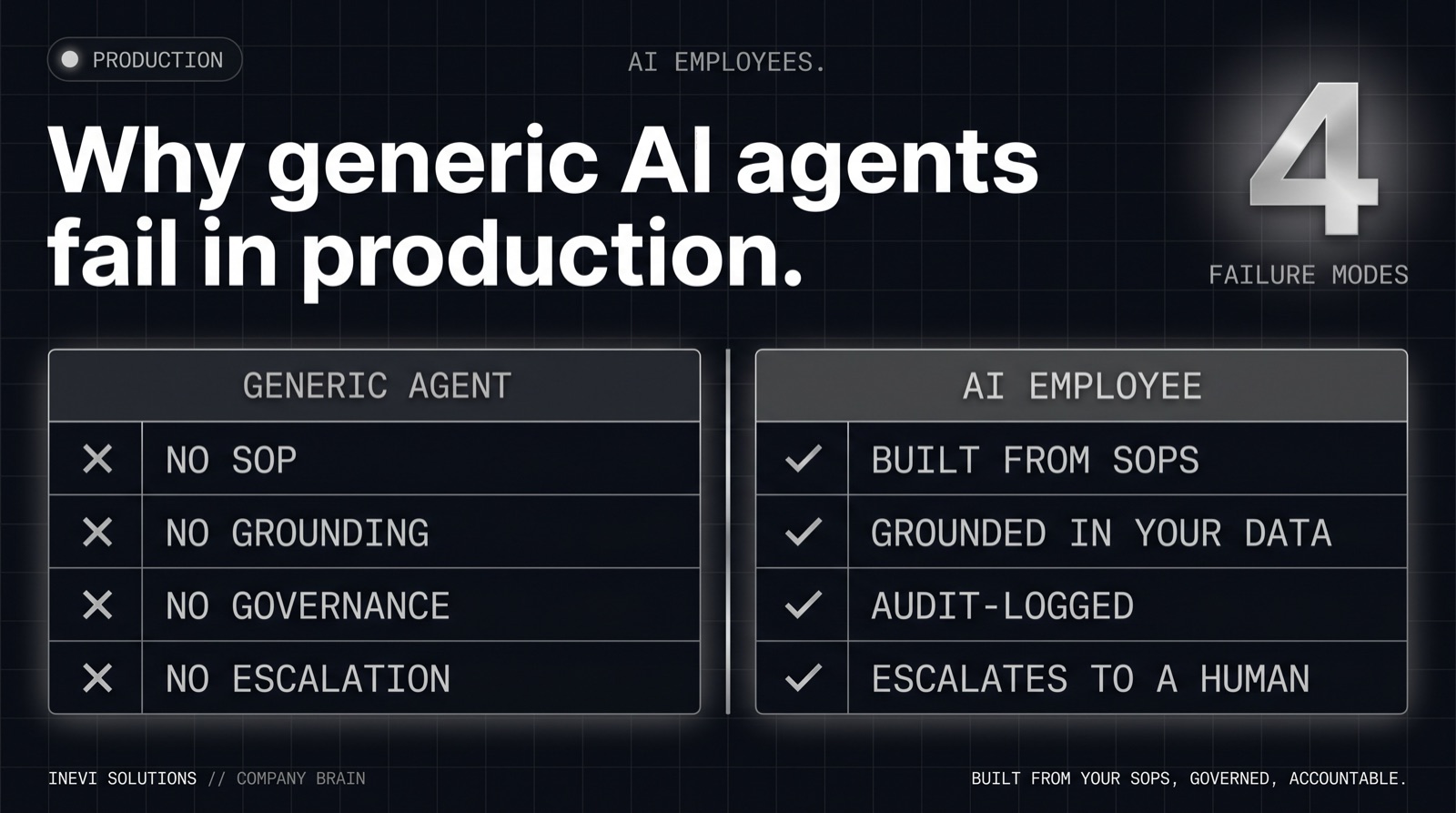
It's almost never the model. It's the four things around the model that a generic agent doesn't have:
- 01No SOP. A generic agent improvises from general knowledge. Your business doesn't run on general knowledge — it runs on the specific way you do intake, the edge cases you've learned the hard way, the exceptions that have a reason. With no encoded procedure, the agent is confidently wrong on exactly the cases that matter most.
- 02No grounding. Without retrieval over your real data, the agent answers from training, not from your account, your policy, your record. In a demo that's invisible. In production it's a wrong answer to a real customer.
- 03No governance. No audit log means no way to see why it did what it did, no way to improve it, and no way to trust it with anything consequential. Operators feel this immediately and pull it back to "suggestions only," which is where most agent projects quietly die.
- 04No escalation path. A generic agent either does the whole thing or nothing. Real roles have a line — past it, a human decides. An agent with no human-in-the-loop checkpoint forces you to choose between full autonomy on day one (too risky) or no autonomy (no point).
Each of these is survivable in a demo because a demo is the happy path by definition. Production is the exceptions, the edge cases, and the consequences. That's the environment an AI employee is designed for and a generic agent isn't.
What an AI employee does differently
Same model, different system around it. The four gaps above, closed:
- It's built from your SOPs — the actual procedure for the role, including the exceptions, encoded as its operating logic. The workflow map is where that procedure gets written down precisely enough to encode.
- It's grounded in your data with retrieval, so it answers from your records, not from a general prior.
- It's governed — every decision logged with context, so you can see why, audit it, and improve it on a schedule instead of hoping.
- It escalates — a defined line where it hands a judgment call to a person, so you get autonomy on the 80% that's mechanical and human judgment on the 20% that isn't.
The honest test of an AI employee isn't "how good is the demo." It's "show me the audit log and the escalation rule." If a vendor can't show you both, you're being sold a generic agent, and you already know how that ends because you've probably tried one.
Where this goes
We think AI employees become the standard unit of work — every operations-heavy team running intake, analyst, support, and reporting employees within a few years, with humans moving up to supervision and the decisions that actually need a person. That's the second of our published predictions. It only holds for AI that's built like an employee. Generic agents won't get there, for the four reasons above.
If you've tried an AI agent and it didn't stick, the takeaway isn't "AI isn't ready." It's that the thing you tried was missing the SOP, the grounding, the governance, and the escalation path. Those are buildable. That's the work.
Related: AI Employees
All posts